
Hi. What are you looking for? Tell us what you need and we'll get back to you.
Bonded Seals
Bonded seals — often called Dowty seals — are self-centring washers with a captive rubber insert bonded inside a steel outer ring. They crush under torque to form a metal-to-metal seal on hydraulic ports, brake lines, fuel systems, and other pressurised fluid connections. Common on BSP and metric fittings where a parallel thread needs a positive seal without PTFE tape or Loctite. The rubber insert handles thermal expansion and surface irregularities; the steel shell prevents over-compression and extrusion. Single-use only — the rubber deforms permanently once torqued, so reusing them invites leaks.
Showing all 2 results
-
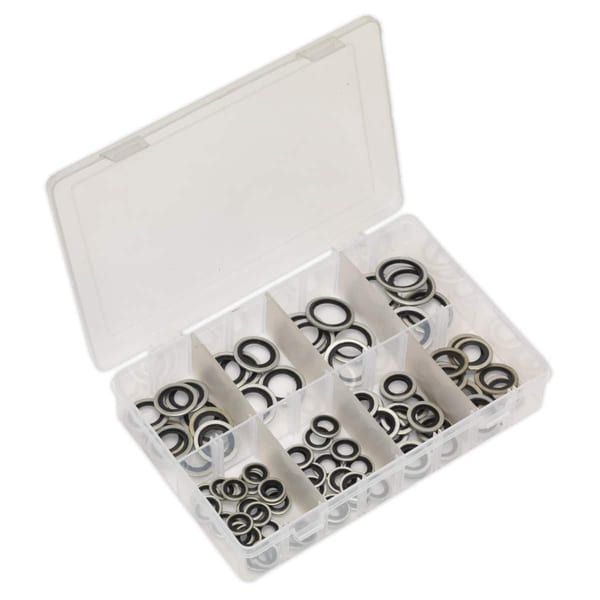 Not yet ratedSealeyBonded Seal (Dowty Seal) Assortment 88pc
- Steel + NBR rubber construction
- Partitioned storage box included
€51.70€52.21€42.03€42.45 -
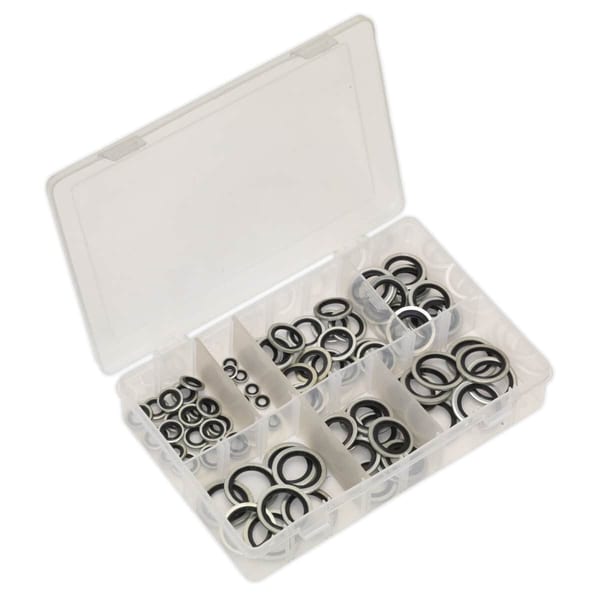 Not yet ratedSealeyImperial BSP Bonded Seal (Dowty Seal) Assortment 84pc
- 84pc assortment, BSP sizes
- Steel + NBR rubber construction
- Includes 1/8″–1″ dia. seals
€51.70€52.21€42.03€42.45
Pick the thread size and pitch to match the fitting — BSP parallel threads (BSPP) use bonded seals, tapered threads (BSPT) do not. Metric sizes are usually specified by the bolt diameter and pitch; imperial sizes by nominal BSP thread. Check whether your system runs metric or imperial fittings before ordering an assortment. The steel shell is typically zinc-plated mild steel; the insert is usually nitrile (Buna-N), which handles mineral oils, diesel, and most hydraulic fluids but degrades in brake fluid (DOT 3/4) and some synthetic oils. If you're sealing brake lines, check the insert material — EPDM is the correct choice there.
Assortments cover the most common sizes in workshop or mobile service work. If you're maintaining a mixed fleet or doing general hydraulic repairs, an assortment saves time hunting single sizes. If you're working on one machine type repeatedly, buy the exact sizes in bulk — you'll go through them faster than you think, and a missing seal will stop the job. Torque to the fitting manufacturer's spec, not until it feels tight. Under-torque and the seal won't crush evenly; over-torque and you'll crack the steel shell or blow out the insert. Once removed, bin it — even if it looks intact, the rubber has already taken a set and won't seal reliably a second time.