
Hi. What are you looking for? Tell us what you need and we'll get back to you.
Extractors
Extractors for removing damaged fasteners — broken bolts, rounded studs, sheared screws. Two main types: helix (spiral flute, left-hand bite) and square taper (hammered or driven into a drilled pilot). Sets cover common sizes; individual impact extractors fit a ratchet or impact wrench for torque on seized metric studs. Sealey and Premier both supply workshop-grade sets.
Showing all 23 results
-
 Not yet ratedPremierBolt Extractor Socket Set 3/8"Sq Drive 11pc
- 11-piece set, 8-19 mm sizes
- 3/8" sq drive, storage case
€144.54€146.00€117.51€118.70 -
 Not yet ratedPremierBolt, Stud & Screw Extractor Set 18pc
- 18-piece set, 3 extractor types
- Chrome Molybdenum + Vanadium
- Internal rollers for stud grip
€174.98€176.75€142.26€143.70 -
 Not yet ratedSealeyDouble Edge Screw Extractor Set 5pc
- 5-piece set, sizes 3.2–15.9 mm
- 4 double-edged cutting sides
- 8-points contact, non-slip grip
€167.38€169.06€136.08€137.45 -
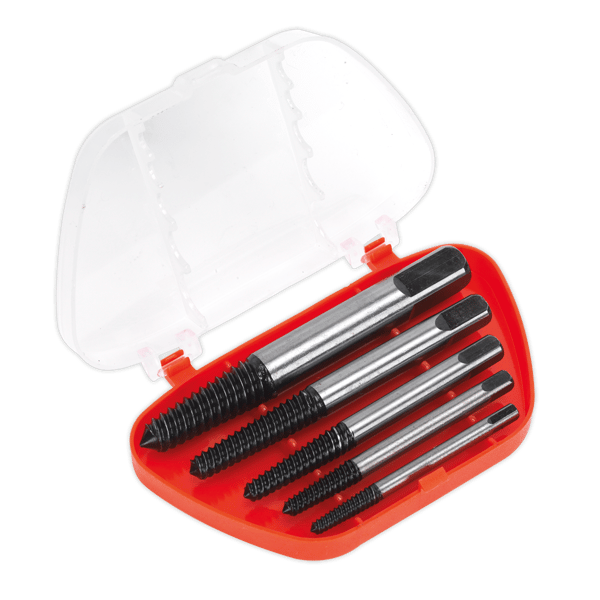 Not yet ratedSealeyHelix Type Screw Extractor Set 5pc
- 5 sizes: 2–18 mm range
- Supplied in storage case
€18.20€18.39€14.80€14.95 -
 Not yet ratedSealeyHelix Type Screw Extractor Set with Wrench 6pc
- 6-piece set, sizes 2-18 mm
- Alloy steel, helix design
- Includes tap wrench + case
€42.56€42.99€34.60€34.95 -
 Not yet ratedSealeyHSS Screw Extractor Set 5pc
- HSS, 5-piece set, sizes #0–#4
- Extracts screws 6–14 mm
- Supplied in storage case
€27.34€27.61€22.23€22.45 -
 Not yet ratedSealeyImpact Stud Extractor 1/2"Sq Drive 6-12mm
- 1/2" Sq drive, 6-12mm capacity
- Chrome Molybdenum jaws
- Air impact wrench compatible
€45.61€46.06€37.08€37.45 -
 Not yet ratedSealeyImpact Stud Extractor 3/8"Sq Drive 6-12mm
- 3/8 in. Sq drive air impact
- Fits studs 6-12 mm
- Carbon Steel + Chrome Molybdenum
€42.56€42.99€34.60€34.95 -
 Not yet ratedSealeyImpact Stud Extractor Set 6-12mm 2pc
- Fits studs 6-12mm
- 1/2" Sq + 3/8" Sq drive
- Chrome Molybdenum jaws
€73.78€75.28€59.98€61.20 -
 Not yet ratedSealeyMaster Extractor Set 35pc
- 35-piece set, 3 extractor types
- Blow-moulded storage case
€187.16€189.05€152.16€153.70 -
 Not yet ratedSealeyMaster Extractor Set 49pc
- 49pc set, Chrome Molybdenum
- Left-handed HSS drill bits
- Multi-spline + spiral flute
€235.86€238.25€191.76€193.70 -
 Not yet ratedSealeyMetric Stud Extractor Set 1/2"Sq Drive 4pc
- Sizes 6, 8, 10, 12 mm
- 1/2" Sq drive fit
€82.14€82.96€66.78€67.45 -
 Not yet ratedSealeyMulti-Spline Screw Extractor Set 10pc
- Reverse spiral design, hex head
€41.03€41.45€33.36€33.70 -

-
 Not yet ratedSealeyScrew Extractor Set 3/8"Sq Drive 6pc
- 6-piece set, 2–10 mm
- Chrome Molybdenum steel
- 3/8″ Sq drive fit
€62.35€62.98€50.69€51.20 -
 Not yet ratedSealeySpanner Type Bolt Extractor Set 11pc
- Reverse spiral flutes, max grip
- Low profile, restricted access
- 9-19mm + 7×90mm drift, 11pc
€45.61€46.06€37.08€37.45 -
 Not yet ratedSealeySpanner Type Bolt Extractor Set 3/8"Sq Drive 11pc
- Reverse spiral flutes for grip
- 9-19mm + 7×90mm drift, 11pc
- 3/8" Sq drive compatible
€71.48€72.20€58.11€58.70 -
 Not yet ratedSealeySquare Type Screw Extractor Set 5pc
- 5-piece set, sizes 1/8–3/8 in.
- Chrome Molybdenum steel
- Square section design
€26.60€26.88€21.63€21.85 -
 Not yet ratedSealeySquare Type Screw Extractor Set 7pc
- 7-piece set, sizes 3-14 mm
- Heat treated alloy steel
- Chemically blackened finish
€53.21€53.75€43.26€43.70 -
 Not yet ratedSealeyStep Drill Screw/Bolt Extractor Set 10pc
- 5 extractors, 5 step drill bits
- Removes right-hand thread screws
- 2.5–14 mm screw sizes
€106.49€107.56€86.58€87.45 -
 Not yet ratedSealeyStud Extractor Set 25pc
- 25-piece set
- Centring pilots 4.75–9.5 mm
- Drill bits 3.2–8.7 mm
€136.94€138.31€111.33€112.45 -
 Not yet ratedSealeyStud Extractor Set 9pc
- Left-hand tapered spiral design
- Sizes 2-6mm + 8-14mm
- 3/8″ + 1/2″ square drive
€106.49€107.56€86.58€87.45 -
 Not yet ratedSealeyTRX-Star* Fitting Extractor Set 11pc
- S2 steel, chrome plated
- 11-piece set, sizes E10-E55
€44.08€44.53€35.84€36.20
Helix extractors grip inside a drilled hole and turn anticlockwise as you back the fastener out — the tighter it jams, the harder they bite. They work well on screws with enough remaining shank. Square-taper extractors are hammered into an undersized pilot hole, then turned with a wrench or socket; the taper wedges into the hole as you apply torque. Pick helix for accessibility and controlled removal, square for stubborn bolts where impact is an option.
Impact stud extractors are a different tool entirely: a six-point socket with reverse-spiral internal teeth. Slip it over the protruding stud, strike or drive it on, and the spiral grips as you turn. They're fast on rounded or damaged hex heads and work with standard impact guns or ratchets. Sizes typically run 6 mm to 12 mm; check the stud diameter and condition before choosing drive size—3/8" for lighter work, 1/2" for higher torque.
Drill the pilot hole straight and to the extractor's specified diameter. Too small and you'll snap the tool; too large and it won't grip. Use cutting fluid, especially in stainless or hardened fasteners, and back off if you feel the extractor start to twist under load. If a helix extractor does break off flush, you're usually into drilling it out or a machine shop. Match the extractor type to access, fastener material, and how much shank is left — there's no one-size solution.